
Private Label and Co-Packing for Frozen Cooked Ingredients: A Buyer’s Guide
How private label and co-packing work for frozen cooked beans, grains, rice and blends, from program steps to labeling rules and what to agree with a manufacturer.
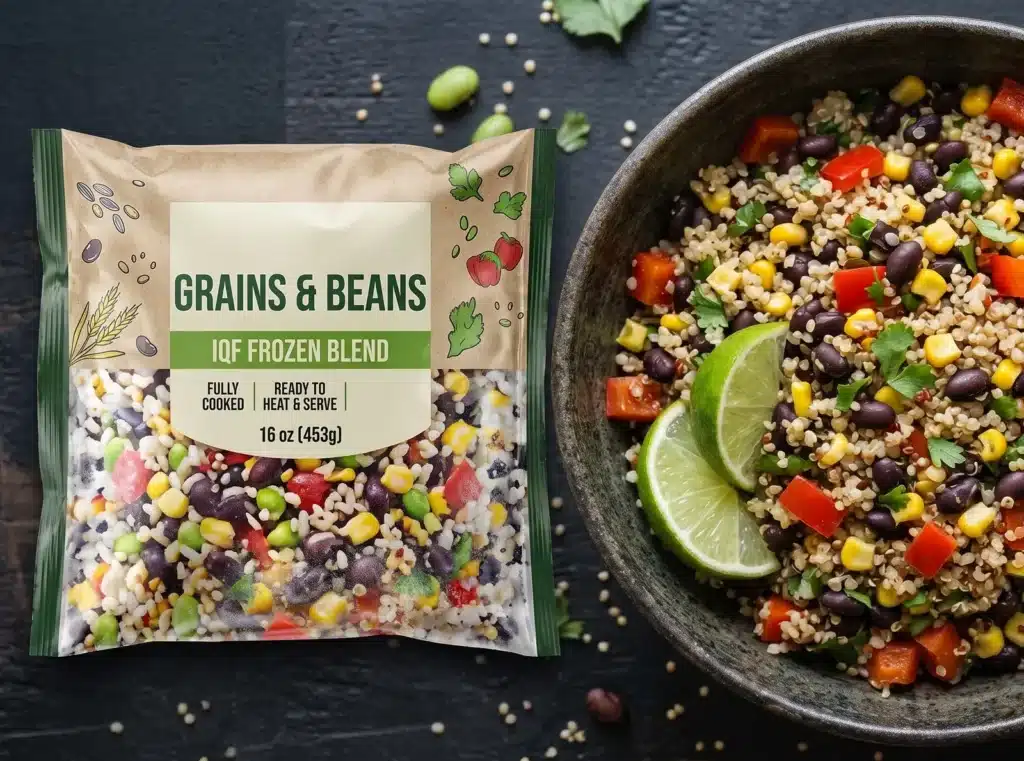
Key takeaways
- Private label sells a manufacturer's product under your brand; co-packing makes it to your spec.
- U.S. private label sales hit a record $282.8 billion in 2025 (PLMA/Circana).
- U.S. labels can name the distributor with 'Manufactured for' or 'Distributed by'.
- Settle spec, packaging, labeling, certifications and traceability before launch.
Short answer: Private label means a manufacturer makes a product that is sold under your brand. Co-packing is the broader arrangement where a manufacturer produces or packs food for another company, to that company’s spec. For frozen cooked ingredients, both let you launch beans, grains, rice or blends under your own label without building a cooking and freezing plant.
Store brands keep growing. U.S. private label sales reached a record $282.8 billion in 2025, up 3.3% on 2024, with a 21.3% dollar share, according to the Private Label Manufacturers Association and Circana; frozen store brand sales rose 2.4% (PLMA). This guide explains how private label and co-packing work for frozen cooked ingredients, and what to settle with a manufacturer before you start.
What is the difference between private label and co-packing?
| Private label | Co-packing (contract manufacturing) | |
|---|---|---|
| Whose brand | Retailer or brand owner | Brand owner |
| Whose recipe | Often the manufacturer’s existing product | Usually the brand owner’s spec or a co-developed one |
| Typical buyer | Retailers, distributors, grocery chains | Food brands, meal kit and prepared-food companies |
| Speed to market | Faster: product already exists | Longer: development and trials |
In practice the two overlap. Many programs start with an existing product, such as plain black beans or a tri-color quinoa blend, and adjust the ratio, cook or pack size for the brand.
How does a private label program work?
- Choose or develop the product. Pick from existing items or co-develop a blend in a set ratio. Seenergy has 200+ SKUs across beans, lentils, grains, rice, pasta and blends.
- Sample and approve. Test samples against full specs and nutrition data. Seenergy samples are free.
- Package your brand. Your artwork on retail bags from 8 oz to 2 lb, or a custom size; bulk cases and totes for foodservice or manufacturing programs.
- Scale the rollout. From pilot stores to national distribution.
What should you settle with a manufacturer before you start?
| Topic | What to agree |
|---|---|
| Specification | Ingredients, ratio, cook level, piece size, nutrition panel, allergen statement |
| Packaging | Bag sizes, film, case pack, pallet pattern, artwork approval process |
| Labeling | Who is named on the label and how (see below) |
| Certifications | GFSI scheme (Seenergy is FSSC 22000 certified), kosher, organic where needed |
| Traceability | Lot coding and recall support; Seenergy tracks every lot in SAP |
| Commercial terms | Volumes, lead times and minimums; at Seenergy these are set with our sales team per program |
Whose name goes on a private label package?
U.S. food labels must name the manufacturer, packer or distributor and its place of business. If the company named on the label didn’t make the food, the name must be qualified with a phrase such as “Manufactured for” or “Distributed by” (21 CFR 101.5). That is how a store brand can carry the retailer’s name while another company makes the product. Confirm the wording with your regulatory team.
Why frozen cooked ingredients suit private label
- Short ingredient lists. Plain beans, grains and rice list only water and the ingredient.
- Ready in minutes. Fully cooked and free-flowing, so shoppers use what they need and reseal the bag.
- Long frozen shelf life. Seenergy’s IQF products are rated for 18 months at 0°F (−18°C).
- Room to differentiate. Custom ratios, seasonings and vegetable inclusions. See custom blends.
Frequently asked questions
What is the difference between private label and co-packing?
Private label is a product made by a manufacturer and sold under a retailer’s or brand’s name. Co-packing is contract manufacturing or packing to another company’s spec. Many programs combine both.
How big is the U.S. private label market?
U.S. private label sales reached a record $282.8 billion in 2025, with a 21.3% dollar share, according to PLMA and Circana.
Does a private label package have to name the manufacturer?
No. Under 21 CFR 101.5 the label can name the distributor instead, qualified with wording such as “Distributed by” or “Manufactured for.”
What pack sizes are available for private label IQF products?
Retail bags from 8 oz to 2 lb or a custom size, plus bulk cases and totes for foodservice and manufacturing programs.
Next step: see our private label program or request free samples.
Sources: PLMA, U.S. private label industry reached $282.8 billion in sales in 2025 (Jan. 2026); 21 CFR 101.5; Seenergy Foods product specifications.
Next step
See how it runs in your process.
Request a sample of fully cooked IQF beans, grains, rice or pasta and test it on your own line or menu.