
The Complete Guide to IQF Ready-to-Eat Grains for Buyers
Fully cooked IQF grains: quinoa, farro, barley, bulgur, couscous, oats and more, which contain gluten, where each works, organic options and pack sizes.
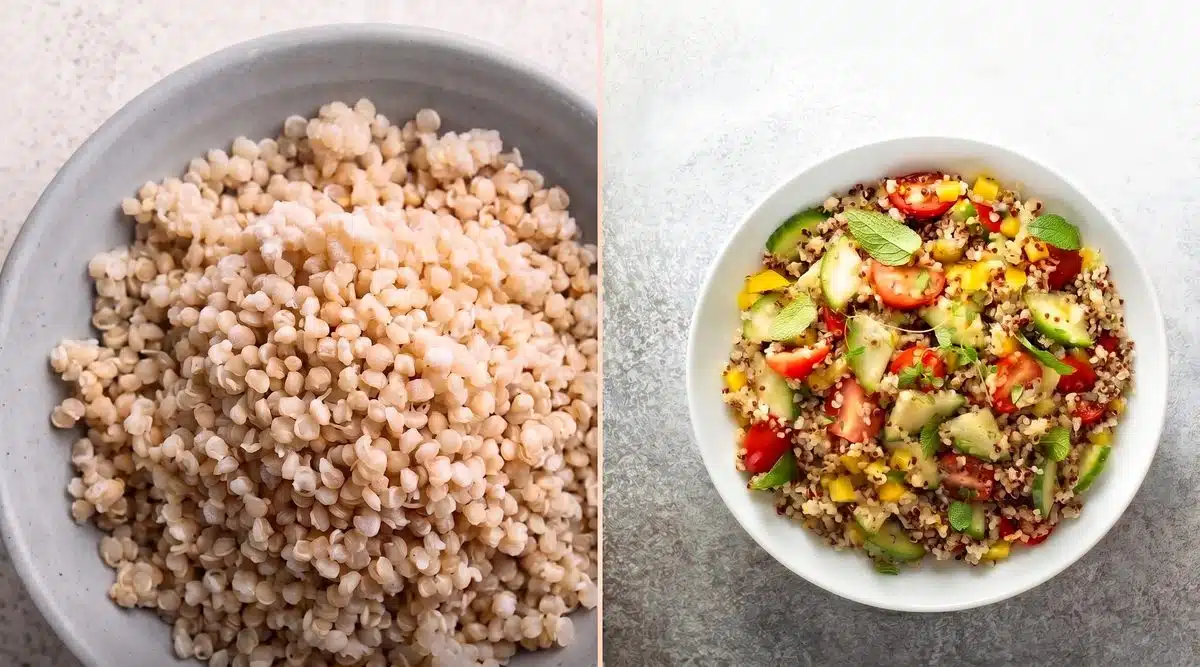
Key takeaways
- Seenergy makes 19 fully cooked IQF grains, from quinoa and farro to bulgur, couscous, barley and oats.
- Quinoa, millet, buckwheat and sorghum list no gluten; wheat, barley and regular oat grains contain it.
- Farro, spelt and black barley carry the most protein, at 5.3–5.5 g per 100 g.
- Most grains ship in 35–40 lb bulk cases and 1,300 lb totes.
Short answer: Fully cooked IQF grains are cooked, drained and individually quick frozen, so they pour free and go straight into bowls, salads, soups and production lines. The main things to check are gluten status, texture, organic status and pack format.

Which IQF grains are available?
Seenergy makes 19 fully cooked IQF grains, each made with just the grain and water.
| Grain (cooked, IQF) | Texture and best for | Protein / fiber per 100 g | Gluten (per spec sheet) | Organic |
|---|---|---|---|---|
| White, red and black quinoa | Light with a slight pop; bowls, salads, breakfast bowls, veggie burgers | 4.4 g / 2.8 g | None listed | Yes |
| Millet | Small and soft; bowls, porridge, baby and pet food | 3.5 g / 2.9 g | None listed | Yes |
| Buckwheat | Earthy; kasha, porridge, soups | 3.4 g / 2.7 g | None listed | Yes |
| Sorghum | Round and chewy; bowls, salads, gluten-free sides | 3.5 g / 2.2 g | None listed | No |
| Farro, spelt | Chewy and nutty; salads, bowls, farrotto, soups | 5.5 g / 3.9 g | Contains wheat and gluten | No |
| Black barley | Firm and dark; bowls, salads, color in blends | 5.3 g / 6.0 g | Contains gluten | No |
| Pot barley | Soft and plump; beef and barley soup, grain salads | 2.3 g / 3.8 g | Contains gluten | Yes |
| Bulgur (light #2, coarse #3, whole brown) | Tender; tabbouleh, pilafs, kibbeh, plant-based fillings | 3.8 g / 4.1 g | Contains wheat and gluten | No |
| Wheat berries | Chewy; grain salads, salad kits, soups | 3.8 g / 4.1 g | Contains wheat and gluten | No |
| Couscous (small, pearl, whole wheat) | Soft; salads, sides, Mediterranean bowls | 3.8 g / 0.9 g | Contains wheat and gluten | No |
| Whole oats, steel cut oats | Hearty; overnight oats, oatmeal, breakfast bowls | 4.6 g / 3.7 g | Contains or may contain gluten | Organic gluten-free steel cut option |
Which IQF grains are gluten-free?
Quinoa, millet, buckwheat and sorghum list no gluten on their spec sheets, and there is an organic gluten-free steel cut oat option. Farro, spelt, bulgur, wheat berries and couscous contain wheat and gluten; barley contains gluten; regular oats contain or may contain gluten. If you make a gluten-free claim, check the cross-contact statement on each spec sheet as well as the allergen list.
Which grain fits which application?
- Bowls and grain salads: quinoa, farro, sorghum, black barley and wheat berries keep their shape and bite when served cold.
- Soups: pot barley, farro and buckwheat hold up in broth.
- Breakfast: steel cut oats, whole oats, millet and buckwheat for porridge, overnight oats and breakfast bowls.
- Plant-based fillings and patties: bulgur, quinoa and millet add body and bind with other ingredients.
- Mediterranean dishes: bulgur for tabbouleh and kibbeh, couscous for salads and sides.
- Baby food and pet food: millet and pot barley are common choices.
What should you specify when buying IQF grains?
- Gluten status. Use the table above to separate grains with no listed gluten from wheat, barley and oat grains.
- Cook level. Firmer for salads and dishes that will be reheated; softer for porridge and baby food. Our R&D team adjusts the cook per item.
- Bulgur grade. Light #2 is fine for tabbouleh; coarse #3 suits pilafs and kibbeh; whole brown bulgur is the largest piece.
- Organic. Available on white, red and black quinoa, millet, buckwheat and pot barley, plus the gluten-free steel cut oats.
- Pack format. Retail bags from 8 oz to 2 lb; foodservice cases of 20 to 24 lb (6 × 4 lb bags on quinoa and farro); bulk cases of 40 lb for most grains, 35 lb for quinoa and pearl and whole wheat couscous, 30 lb for small couscous; totes of 1,300 lb for most grains.
- Blends. Grains also come pre-mixed in set ratios. See our quinoa blends, IQF blends and custom blends.

Frequently asked questions
Do IQF grains need to be cooked?
No. They are fully cooked. Heat them from frozen, or thaw them under refrigeration for salads and cold bowls.
Which IQF grains are gluten-free?
Quinoa, millet, buckwheat and sorghum list no gluten on their spec sheets, and an organic gluten-free steel cut oat option is available. Farro, spelt, bulgur, wheat berries, couscous and barley contain gluten.
Which IQF grain has the most protein?
Farro and spelt, at 5.5 g per 100 g, followed by black barley at 5.3 g and oats at 4.6 g.
Which IQF grains come in organic?
White, red and black quinoa, millet, buckwheat, pot barley and gluten-free steel cut oats.
How long do IQF grains last?
18 months frozen at 0°F (−18°C). Once thawed, keep them refrigerated and use them promptly.
Next step: see all IQF grains, read our IQF rice guide, or request free samples.
Source: Seenergy Foods product specifications.
Next step
See how it runs in your process.
Request a sample of fully cooked IQF beans, grains, rice or pasta and test it on your own line or menu.