
Freezing keeps food from spoiling. How you freeze it decides if the pieces pour out smooth, cook right, and taste close to fresh.
IQF is the line between premium frozen food and the junk that turns to mush. You have probably seen IQF on a bag and wondered what makes it different.
Or what happens inside an IQF freezer that makes it different from regular blast freezing. This guide breaks it all down and shows you when IQF beats other freezing methods.
What Is IQF Technology?
IQF stands for Individual Quick Freezing. Each piece freezes on its own instead of clumping into one big block.
The whole point is freezing things fast enough that they stay separate, keep their shape, and portion out easy. Sounds simple but pulling it off takes serious equipment.
People hear IQF and think it just means freezing things fast so they do not clump. Sure. But that is not why it matters. Fast freezing changes how ice forms inside the food at a cellular level, and that is what protects texture.
That internal change is what protects texture, reduces drip loss, and keeps food looking like food after thawing.
IQF works for fruits, vegetables, seafood, poultry, you name it. Shows up in retail bags at the grocery store.
Restaurant kitchens portion it out fast. Manufacturers toss it right into their recipes with zero prep work. That kind of flexibility is why premium frozen food companies all use IQF now. It stopped being a nice-to-have and turned into a must-have.
The Science in 60 Seconds
Freezing always follows the same path. Food gets cold. Water inside starts turning to ice. Everything goes solid once all the water freezes. The part that matters most is when liquid water becomes ice crystals because that is when damage happens.
Slow freezing allows ice crystals to grow large. Those large crystals rupture cell walls and push moisture out of the structure.
Fast freezing creates many small crystals instead, which fit inside the cell structure with less damage.
That difference explains why IQF freeze products hold texture better after thaw. Smaller crystals mean less cellular collapse and lower drip loss.
So when processors focus on what is IQF freezing, they are really controlling crystal size through speed and airflow.
IQF vs Flash Freezing vs Blast Freezing
The terminology around freezing confuses buyers and marketers alike. Flash freezing is often used as a consumer term, not a technical one. In practice, flash freezing usually describes any fast freezing process, including IQF and blast freezing.
IQF freezing is a specific outcome. Individual pieces remain separate and free flowing after freezing. Blast freezing describes a method, not a result, and often freezes products in trays or racks.
People use the terms interchangeably in marketing. That is where confusion starts. Technically, IQF can use blast air, cryogenic cooling, or hybrid systems, as long as individual separation is achieved.
How IQF Differs From Traditional Freezing Methods
Block Freezing and Cold Store Freezing
Block freezing is the baseline slow freeze method. Products freeze in cartons, bins, or bulk blocks over long dwell times. Ice crystals grow large, moisture migrates, and pieces fuse together.
Texture degradation and drip loss increase as freezing time increases. Clumping becomes unavoidable for particulate products.
Cold store freezing still works well for bulk ingredients held long term where piece integrity does not matter.
For premium retail or foodservice use, block freezing fails on portioning and visual quality.
That is why IQF freezing replaced it in most value driven frozen categories.
Blast Freezing
Blast freezing uses high velocity cold air across trays or racks. It freezes faster than cold storage and improves quality. For large pieces or packaged items, blast freezing performs reliably.
The limitation appears with small, loose pieces. Tray handling creates labor constraints and limits throughput. Blast freezing can deliver IQF-like results in some cases, but consistency suffers at higher loads.
Plate Freezing
Plate freezing presses packaged food between cold metal plates. It freezes quickly and evenly for uniform blocks. Fish fillets, slabs, and flat packaged products benefit most.
Pressure and shape control make plate freezing unsuitable for IQF freezing. Pieces deform and fuse by design. It solves a different problem and does not replace an IQF freezer.
The IQF Process Step by Step
Step 1: Raw Material Intake and Preparation
IQF quality is won or lost before freezing begins. Raw material variability directly affects freezing behavior. Sorting, sizing, and trimming improve uniform exposure to cold air.
Washing removes field debris and reduces microbial load. Pre-cooling lowers thermal load entering the freezer. Lower inlet temperature improves freezing efficiency and reduces ice buildup.
Step 2: Blanching for Vegetables
Blanching controls enzymes that cause color and flavor loss during storage. Not all vegetables require blanching, but skipping it shortens shelf life.
The process includes heating, rapid cooling, and dewatering. Brands targeting long storage stability rely on blanching before IQF freezing.
Step 3: Surface Moisture Control
Surface water is one of the most common IQF failures. Excess moisture causes clumping and snow buildup. Effective dewatering ensures pieces freeze individually.
Some applications use light oiling or coatings. This modifies heat transfer and reduces sticking.
It must be controlled carefully to avoid insulating the surface.
Step 4: Individual Quick Freezing Stage
Inside an IQF freezer, cold air flows upward through the product bed. Fluidization lifts and separates pieces so air contacts all surfaces evenly.
Some lines use crust freezing first, then freeze to core later. This balances throughput, shape retention, and energy use.
Step 5: Post Freeze Handling
After freezing, vibratory conveyors and screens break weak clusters. Seafood products may receive glazing to protect against dehydration.
Packaging includes metal detection, checkweighing, and case packing. Free flow quality improves packing speed and accuracy.
Step 6: Frozen Storage and Cold Chain
IQF products store best at stable low temperatures with controlled humidity. Poor loading patterns and temperature cycling cause freezer burn.
Good cold chain discipline preserves the benefits gained during IQF freezing. That consistency protects brand quality through distribution.
Rapid Freezing Techniques Used in IQF
Mechanical IQF Systems
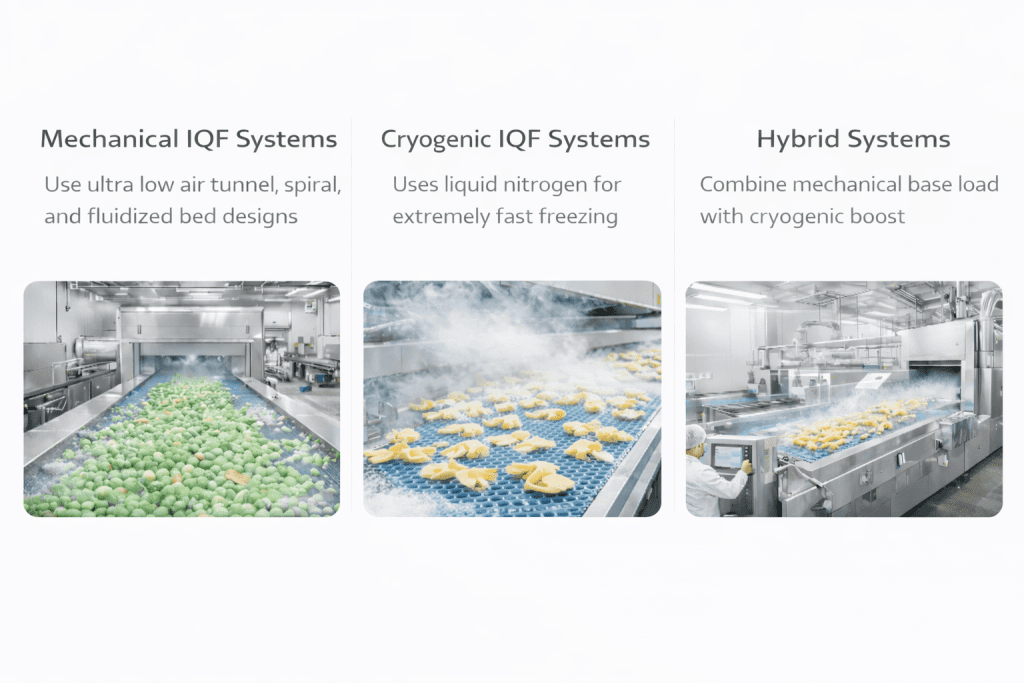
Mechanical IQF freezers use refrigerated air. Ultra low air refers to very cold, high velocity airflow. Tunnel, spiral, and fluidized bed designs are common.
These systems offer predictable operating costs and long service life. They suit high volume, continuous operations.
Cryogenic IQF Systems
Cryogenic systems use liquid nitrogen or carbon dioxide. Freezing happens extremely fast. Quality retention is excellent due to minimal crystal growth time.
Operating cost depends on gas supply and usage rate. They shine in premium seafood, seasonal peaks, and R and D production.
Hybrid Systems
Hybrid systems combine mechanical base load with cryogenic boost. They balance speed, flexibility, and energy efficiency.
Hybrid IQF freezing fits plants with mixed product portfolios. It allows capacity scaling without full system replacement.
IQF Equipment Types and Selection
Fluidized Bed Freezers
Fluidized bed freezers are the true IQF workhorse. They excel with peas, berries, diced vegetables, and shrimp.
Fluidization prevents pieces from sticking by keeping them suspended. This ensures uniform freezing and free flow.
Tunnel Freezers
Tunnel freezers handle sliced or irregular products well. They support flexible product changeovers.
With correct loading, tunnels deliver IQF-like performance. They often cost less than full fluidized systems.
Spiral Freezers
Spiral freezers suit coated and prepared foods. They maximize capacity per square meter.
For continuous lines, spirals reduce cost per kilogram frozen. They are less common for raw particulate IQF freezing.
Practical Selection Matrix
Product shape, fragility, throughput, space, and budget drive decisions. No single IQF freezer fits all applications.
Matching equipment to product behavior delivers consistent results. That is where experienced system design matters most.
Benefits of IQF Freezing
Quality Preservation
IQF freezing protects product quality by forcing water inside the food to freeze rapidly into small, evenly distributed ice crystals.
These microcrystals cause significantly less damage to cell walls than the large crystals formed during slow freezing.
In practical terms, this means fruits stay firm instead of mushy, vegetables retain bite, and proteins release less purge during thaw.
That result is the real answer to what is IQF freezing when quality claims must survive customer handling, cooking, and storage.
Color retention improves because cellular structure remains intact, limiting oxidation and pigment breakdown.
Flavor holds better because moisture and soluble compounds stay inside the product instead of leaking out during thaw.
Free-Flowing Product
IQF freezing keeps individual pieces separate by freezing surface moisture almost instantly.
Because pieces do not fuse together, the finished product pours cleanly instead of breaking apart in clumps.
Retail customers can grab exactly what they need from the bag. No thawing first. No cutting. Just pour and go. Restaurants get portions ready faster, waste less food from scooping out too much, and every dish comes out the same.
Free flow also improves downstream operations. Scales, form-fill-seal machines, and volumetric fillers perform more accurately when product behavior is predictable.
Yield and Efficiency
IQF freezing cuts down on drip loss when food thaws. Less liquid dripping out means you keep more weight. That weight is money because you sell by the pound.
Keep more moisture in and fewer packs get rejected for being underweight. You stay compliant with the weight printed on the label. For expensive stuff like shrimp or premium berries, that difference pays for the IQF system pretty fast.
Product flows better through packing and into cases when pieces do not stick together. Workers spend less time breaking up clumps or fixing jammed lines. Fewer stoppages mean the line keeps running.
Food Safety Reality
IQF makes food safer but it does not kill bacteria. Freezing slows down how fast microbes grow by dropping the temperature and locking up water they need. Bacteria go dormant but they do not die.
However, pathogens present before freezing can survive and become active again after thawing. That is why sanitation, blanching control, and cold chain discipline remain critical.
IQF supports food safety programs by stabilizing product conditions. It does not replace proper HACCP design, validated controls, or good manufacturing practices.
Applications of IQF by Category
Fruits and Vegetables
IQF freezing is widely used for fruits and vegetables because it preserves piece integrity while allowing free-flowing packs.
Berries, mango, peas, and corn maintain shape, color, and bite when frozen rapidly and individually. Blanching decisions depend on enzyme activity and intended shelf life.
Products intended for long storage or retail distribution typically require blanching, while short-life or foodservice applications may skip it.
Uniform sizing and surface moisture control are critical in this category. Inconsistent preparation leads directly to clumping and uneven freezing.
Seafood and Poultry
Seafood and poultry rely on IQF freezing to protect yield and appearance. Shrimp, scallops, and diced chicken benefit from fast freezing that limits moisture loss during thaw.
Glazing is commonly applied after freezing to create a protective ice layer. This glaze reduces dehydration, oxidation, and freezer burn during storage.
Because proteins carry higher food safety risk, process control is critical. IQF stabilizes the product but depends on strict sanitation and cold chain discipline to maintain quality.
Convenience Foods
IQF freezing supports portionable components used in prepared foods. Nuggets, fries, and meal inclusions freeze individually so they can be dosed accurately into final packs.
Spiral and tunnel IQF systems dominate this category due to product size and coatings. Freezer selection depends on whether the product is raw, par-fried, or fully cooked.
Consistent freezing improves downstream assembly and reduces weight variability. That consistency matters most in high-volume ready-meal production.
Non Obvious Categories
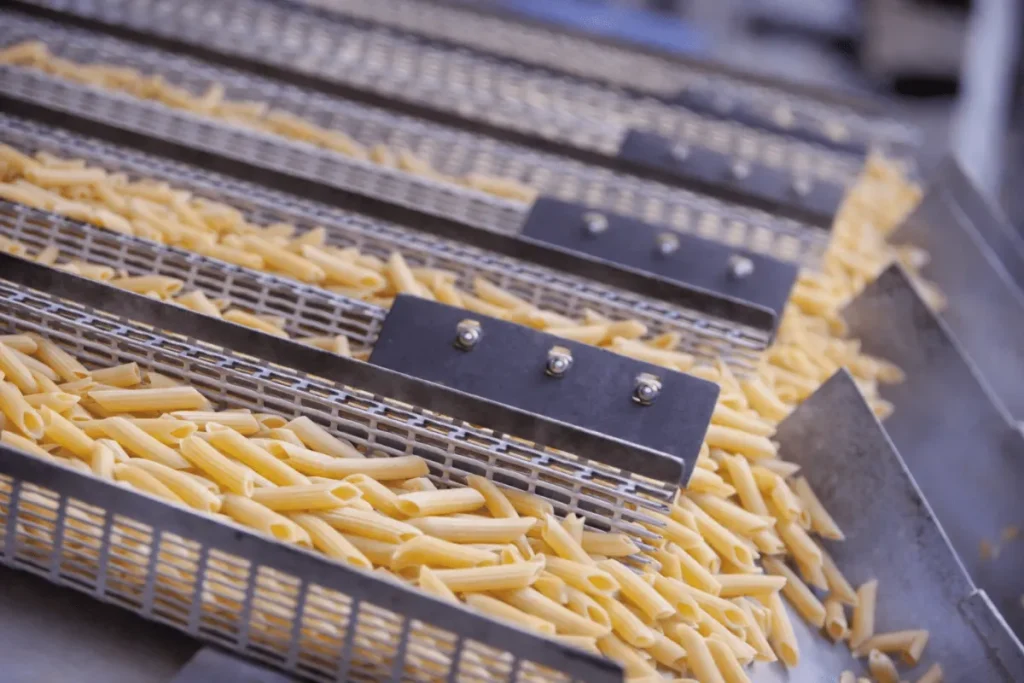
IQF freezing is increasingly used for products not traditionally frozen individually. Pasta, cheese, and grains benefit from separation and flow during portioning.
Free-flow behavior improves dosing accuracy in automated systems. That reduces give-away and improves pack weight consistency.
These applications often require customized airflow and bed depth control. Without tuning, product deformation or surface cracking can occur.
Choosing the Right Freezing Solution
Product type and target market
Match the freezing method to product format and whether the end use requires free-flowing retail packs or bulk foodservice handling.
Throughput and run schedule
Size the freezer for peak hourly demand and determine whether production runs continuously or in shorter batch windows.
SKU variety and changeover needs
Evaluate how often products change and how quickly the system can be cleaned, adjusted, and restarted without yield loss.
Budget preference (CAPEX vs OPEX)
Decide whether lower upfront cost or lower long-term operating expense aligns better with financial strategy.
Return on investment drivers
Focus ROI analysis on yield retention, labor reduction, packing speed, and reject reduction rather than freezer capacity alone.
Appropriateness of small IQF capacity
Choose small-scale IQF only when demand, margins, or pilot objectives clearly justify the complexity.
Vendor validation and guarantees
Require test runs, performance guarantees, and documented results using real product conditions.
Maintenance and long-term reliability
Prioritize systems that support easy access, predictable servicing, and high uptime over theoretical maximum performance.
Conclusion
IQF freezing delivers measurable quality, yield, and operational advantages when applied correctly. Understanding what is IQF freezing helps buyers and processors avoid costly mismatches.
If you want guidance on IQF freezing solutions built for real production goals, explore the expertise at Seenergy Foods and start the right conversation today.
FAQs
What is IQF freezing in food processing?
IQF freezing is a method where individual food pieces are frozen rapidly and separately. This prevents clumping and helps preserve texture, shape, and portion control.
Why does IQF freezing protect texture better than slow freezing?
IQF freezing forms smaller ice crystals inside the food. Smaller crystals cause less damage to cell walls, reducing drip loss and maintaining firmness after thawing.
Is IQF the same as flash freezing?
No. Flash freezing is a marketing term that usually refers to fast freezing in general. IQF describes a specific result where pieces remain free flowing after freezing.
How is IQF different from blast freezing?
Blast freezing is a method using cold air, while IQF is an outcome. Blast freezing may still result in clumping, whereas IQF ensures individual separation when properly controlled.
Is blanching always required before IQF freezing?
No. Blanching is mainly used for vegetables to control enzymes. Some products and short shelf-life applications can skip blanching depending on quality goals.
Can IQF freezing be used for non-traditional products?
Yes. Products like pasta, cheese, and grains increasingly use IQF freezing to improve dosing accuracy and automated handling.
How do I know if IQF freezing is right for my operation?
IQF is most suitable when product quality, portion control, yield retention, and packing efficiency are critical to your business goals.